1980: "Stardust Memories"
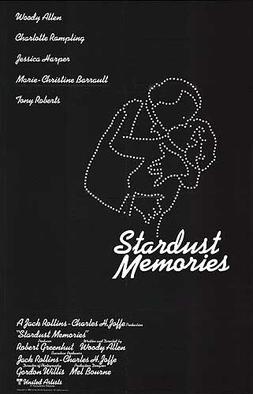
Stardust Memories is Woody Allen's homage/parody to Fellini's 8 1/2 (a meditation on 'director's block'), with Allen starring as a director (somewhat based on himself) who tries to make more artistic films rather than the silly comedies he's known for (somewhat based on Allen's career trajectory, from the silliness of Take the Money and Run to the more artistically inclined Manhattan). Along the way, he reflects on his past relationships (somewhat based on EVERY movie Allen's ever made).
I never knew what to make of Stardust Memories (I still don't after three attempts). It can be both very funny and admirable for its audacity, but annoying and dull in its naval-gazing. It's a film that seems like it's trying to have it both ways: a fairly sly parody of self-indulgent artistic quests like 8 1/2 (with maybe a touch of Sullivan's Travels), while also indulging in the same.
The movie is peppered with very funny moments and details (like the wallpaper in his apartment ranging from Groucho Marx to that famous photo of Nguyen Van Lém's execution). There's even some lovely moments of Gordon Willis cinematography peppered throughout (like the opening train sequence or the sequence in that forest clearing). But, if you've already noticed my consistent use of the word 'peppered', it's few and far-between. If you heard me watching the film from another room, you would think I was watching an uneven comedy.
And maybe it's just me, but Allen's movies are all essentially the same film, just with a different coat of paint. Nebbish and insecure Woody Allen with existentialist view on life while also reflecting on failed relationships. He consistently changes his style and gimmicks (Stardust Memories an 8 1/2 parody, Husbands and Wives a pseudo-documentary, Zelig a historical and intellectual study on a fictional creation, Purple Rose of Cairo a meta-fantasy, A Midsummer Night's Sex Comedy a takeoff of Bergman's Smiles of a Summer Night) but the basic story never seems to change. And when I watch Allen reflecting on his relationships in this movie, it just seems stale. And I'm not quite sure how these failed romances even reflect on Allen's own stunted creativity. It just doesn't cohere into anything.
Going the self-reflexive route is the last refuge of an artist with no new ideas. Granted, I could almost understand Allen going in this direction at this point in his career. After the rousing success of Annie Hall and Manhattan, Allen became an important filmmaker, rather than just another funny Jewish guy from Brooklyn. This meteoric rise was probably too sudden for Allen so he decided to compose a reflective work on his new reputation. I give the movie props for ambition and a few laughs, but it's ultimately self-indulgent.
I never knew what to make of Stardust Memories (I still don't after three attempts). It can be both very funny and admirable for its audacity, but annoying and dull in its naval-gazing. It's a film that seems like it's trying to have it both ways: a fairly sly parody of self-indulgent artistic quests like 8 1/2 (with maybe a touch of Sullivan's Travels), while also indulging in the same.
The movie is peppered with very funny moments and details (like the wallpaper in his apartment ranging from Groucho Marx to that famous photo of Nguyen Van Lém's execution). There's even some lovely moments of Gordon Willis cinematography peppered throughout (like the opening train sequence or the sequence in that forest clearing). But, if you've already noticed my consistent use of the word 'peppered', it's few and far-between. If you heard me watching the film from another room, you would think I was watching an uneven comedy.
And maybe it's just me, but Allen's movies are all essentially the same film, just with a different coat of paint. Nebbish and insecure Woody Allen with existentialist view on life while also reflecting on failed relationships. He consistently changes his style and gimmicks (Stardust Memories an 8 1/2 parody, Husbands and Wives a pseudo-documentary, Zelig a historical and intellectual study on a fictional creation, Purple Rose of Cairo a meta-fantasy, A Midsummer Night's Sex Comedy a takeoff of Bergman's Smiles of a Summer Night) but the basic story never seems to change. And when I watch Allen reflecting on his relationships in this movie, it just seems stale. And I'm not quite sure how these failed romances even reflect on Allen's own stunted creativity. It just doesn't cohere into anything.
Going the self-reflexive route is the last refuge of an artist with no new ideas. Granted, I could almost understand Allen going in this direction at this point in his career. After the rousing success of Annie Hall and Manhattan, Allen became an important filmmaker, rather than just another funny Jewish guy from Brooklyn. This meteoric rise was probably too sudden for Allen so he decided to compose a reflective work on his new reputation. I give the movie props for ambition and a few laughs, but it's ultimately self-indulgent.

Comments
Post a Comment