1980: "Popeye"
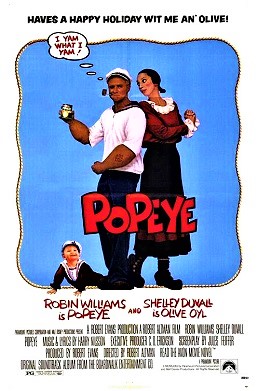
Popeye is......an awkward film, to say the least. For the obvious reasons, of course. Live-action adaptations of cartoons are risky, especially trying to recreate the anatomically ridiculous character designs of many Popeye characters. I mean, you can't really pull off Popeye's balloon-like forearms or the prominent fist-like chin without obvious prosthetics. Nor can you pull off the physics-defying slapstick of the cartoons. I rewatched a few of the old Fleischer shorts and they still hold up in terms of innovative gags and lithe animation. The movie only achieves this in the last twenty minutes, when it finally becomes a Popeye film. Comparing the movie to the shorts is rather arbitrary so we'll move on.
I think a lot of the film's awkwardness comes from the film's director, Robert Altman, which may be the strangest directorial choice in history. It's like a Mr. Magoo movie directed by Andrei Tarkovsky. If you've watched any of Altman's films, the man looooved wide shots. Altman used his wide shots as a sort of detached microscope, showing all these various characters like ants in an ant farm. There's a certain drollness to them that's only unique to his films. Sometimes, comedy is about framing and there's a method to how comedy is framed. When Altman uses his approach to a slapstick comedy, it's off-putting. We see all the familiar faces like Winky, and Swee' Pea, and Bluto, but they're all framed in this weird, anthropological way, like we're watching a wry sociological documentary about the world of Popeye. Though if there's one aspect where Altman's and Popeye's sensibilities match, it's the use of sound. Altman used a lot of dense, overlapping dialogue and Popeye cartoons were a polyphony of sound (especially Popeye's muttering, catch-it-or-you'll-miss-it asides that are often heard right in the middle of the action).
It's awkward, but does the movie succeed despite this? I would say yes and no. A large chunk of the film (I'd say the first two-thirds; it's also a little under two hours) doesn't go anywhere and is rather meandering yet it retains a refreshingly off-beat tone and some of the comedic bits actually work. The music is delightfully unconventional (all by Harry Nilsson). And like I said before, the last twenty minutes actually do replicate the cartoons very well. The acting is its biggest strength. The best actor, and easily my favorite aspect of the film, is Shelley Duvall as Olive Oyl. She is pitch-perfect, with the voice ("Oooooooh, Popeye!"), the mannerisms, and the physical resemblance. She's also hilariously absent-minded and cute as a button. I have never seen a live-action version of a cartoon character executed as beautifully as Duvall's Olive Oyl. Paul L. Smith, a familiar shifty-eyed character actor, is also first-rate casting as Bluto. Robin Williams is perfectly serviceable as Popeye, though I think he's better at doing an impression of Popeye than actually inhabiting him (I kind of had a problem with the reddish-blonde hair that he had).
Popeye is an oddity, but a particularly ambitious one that, although it doesn't quite succeed, it manages to be a pleasant, off-beat interpretation.


Comments
Post a Comment