1980: "Ordinary People"
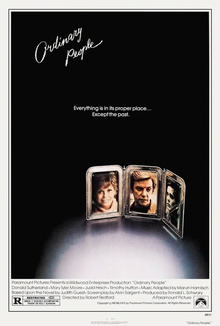
Ordinary People is an 1980 drama about a suburban family (Donald Sutherland as the husband, Mary Tyler Moore as the wife, and Timothy Hutton as the son), dealing, in their own individual way, the grief and trauma over the loss of a family member (Hutton's older brother, Bucky). It was Robert Redford's directorial debut and the winner of the 1980 Academy Award for Best Picture.
The film was okay, if a bit overrated. I enjoyed it as an actor's showcase more than I did the movie as a whole. Because the acting is good. Sutherland and Hutton are both very empathetic and well-rounded people with understandable feelings. Judd Hirsch is wonderful (his scenes with Hutton are the best in the whole movie) as the tough, straightforward but caring psychiatrist.
The movie itself is too conventional. At times, it utilizes rather cheap filmic crutches like flashbacks and voice-overs (to convey what's going on in someone's head) instead of letting the actors express this through their acting. It's also a bit convenient that the movie is located in Lake Forest, Illinois, a hive of "WASP repression" (to borrow a phrase from Pauline Kael's review), which makes their repression all the more understandable (some critics have said that the movie never makes any judgments on its characters and the world around them; I actually think it makes very subtle jabs at that boring upper-crust lifestyle).
My biggest sticking point with the movie was Mary Tyler Moore's character, Beth. Beth is portrayed as an aloof matriarch whose pretenses of neatness and bland geniality hide a deeper inability to express her true feelings about the death of her son. The problem is that her character is written as so overly frigid to the point where she seems more like a villain/obstacle for the father and son to overcome. The father and son, for all their faults, at least try to unburden themselves of their feelings (they both go to see Dr. Berger). The scene near the end where Sutherland tells Moore his true feelings seem more like David slaying Goliath than any sort of catharsis, and the father and son are brought closer together because of it. I'm going to echo Kael's criticism a bit in the sense that she's way too WASP-y to have any sympathy for. Her idea of "keeping up appearances" is to, well, play the frosty Protestant that mainstream culture detests. A woman hiding her inner turmoil through suburbanite neatness just seemed false to me and more like the director making a screed toward deadening suburban culture. It felt emotionally dishonest.
I had a somewhat immature hatred of this movie before I even saw it, mainly because the movie beat Raging Bull at the Academy Awards. Of course, Raging Bull should have won, but that's a stupid way to look at movies (as OSCAR winners, since the awards are a joke anyway). Ordinary People is a perfectly fine movie. Perfectly ordinary in every way.
The film was okay, if a bit overrated. I enjoyed it as an actor's showcase more than I did the movie as a whole. Because the acting is good. Sutherland and Hutton are both very empathetic and well-rounded people with understandable feelings. Judd Hirsch is wonderful (his scenes with Hutton are the best in the whole movie) as the tough, straightforward but caring psychiatrist.
The movie itself is too conventional. At times, it utilizes rather cheap filmic crutches like flashbacks and voice-overs (to convey what's going on in someone's head) instead of letting the actors express this through their acting. It's also a bit convenient that the movie is located in Lake Forest, Illinois, a hive of "WASP repression" (to borrow a phrase from Pauline Kael's review), which makes their repression all the more understandable (some critics have said that the movie never makes any judgments on its characters and the world around them; I actually think it makes very subtle jabs at that boring upper-crust lifestyle).
My biggest sticking point with the movie was Mary Tyler Moore's character, Beth. Beth is portrayed as an aloof matriarch whose pretenses of neatness and bland geniality hide a deeper inability to express her true feelings about the death of her son. The problem is that her character is written as so overly frigid to the point where she seems more like a villain/obstacle for the father and son to overcome. The father and son, for all their faults, at least try to unburden themselves of their feelings (they both go to see Dr. Berger). The scene near the end where Sutherland tells Moore his true feelings seem more like David slaying Goliath than any sort of catharsis, and the father and son are brought closer together because of it. I'm going to echo Kael's criticism a bit in the sense that she's way too WASP-y to have any sympathy for. Her idea of "keeping up appearances" is to, well, play the frosty Protestant that mainstream culture detests. A woman hiding her inner turmoil through suburbanite neatness just seemed false to me and more like the director making a screed toward deadening suburban culture. It felt emotionally dishonest.
I had a somewhat immature hatred of this movie before I even saw it, mainly because the movie beat Raging Bull at the Academy Awards. Of course, Raging Bull should have won, but that's a stupid way to look at movies (as OSCAR winners, since the awards are a joke anyway). Ordinary People is a perfectly fine movie. Perfectly ordinary in every way.

Comments
Post a Comment