1980: "The Blues Brothers"
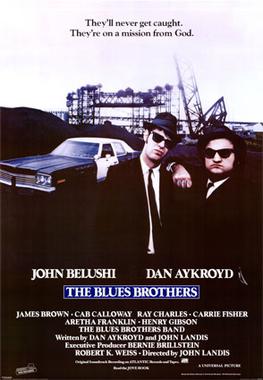
If you were to ask someone what the definitive New York City movie is, you would probably get a dozen diverse answers (though I'd argue Taxi Driver), or if you asked about the definitive Los Angeles movie, you would probably get a ton of film noirs. Chicago, though, not as many. You might get some John Hughes movies, or some 30's-era gangster flick like The Untouchables. But if you were to ask me, a native Chicagoan, what the definitive Chicago movie is, I'd probably answer The Blues Brothers.
And if you're from Chicago, you should be thankful this movie even exists. The Blues Brothers, more than anything, put Chicago on the cinematic map. Chicago became an icon of the eighties due to its ubiquity in American cinema at the time (though most of these movies were made by Chicago natives like John Hughes, Bill Murray, John Landis, and other luminaries from the Chicago-based sketch group, The Second City).
Rewatching The Blue Brothers, I find the movie, in retrospect, to be a pretty miraculous creation because it could easily not work. The movie runs over two hours, has a fairly thin plot (the brothers have to raise money for the orphanage, so they try to get their former band back together), and has a potentially fatal tonal clash with its absurd deadpan humor and its grungy, old school depiction of Chicago. At the same time, it's a movie that could have easily been too conventional and stale, what with this being an opportunity for Saturday Night Live to branch off some of their characters to movies. Not to mention, a very troubled production history, with John Belushi ingesting every sort of drug known to man, and production going exceedingly over-budget. Dan Ackroyd had never written a screenplay before so he supposedly wrote an over-300 page Russian tome (this would be a running theme in Ackroyd's unhinged writing career; see Nothing But Trouble). In essence, this movie had a lot against it.
The Blues Brothers walks a fine tightrope and succeeds beautifully. What could have been a bloated comedy ends up becoming something utterly inventive and engagingly madcap. With confident direction from John Landis, crisp comedic editing, inspired set pieces, energetic musical numbers, great comedic acting, and the some of the most masterfully filmed car chases committed to celluloid, The Blues Brothers is a wonderful romp on the level of It's a Mad Mad Mad Mad World and one of the best comedies of the 1980's. To put it succinctly, it's just pure fun.
Its lack of glamour and sheen is evident from the opening shots of the steel mills spewing fire from its chimneys to the Joliet prison fortress. The movie doesn't establish its tone in the first five minutes but it definitely establishes its surroundings. It's an interesting opening because it's starkly different from the rest of the proceedings, as if the movie can't get its rocks off unless the brothers are together. And when they're finally together, the trumpets blare with all the pomp and heraldry of Heaven Everlasting. But the gritty and unglamorous Chicago acts as a kind of foil to the brothers' deadpan self-solemnity. The brothers themselves are a ridiculous anachronism with their Ray-Bans, porkpie hats, black suits, and ties, the kind of 50's film noir look that Quentin Tarantino emulated in Reservoir Dogs and Pulp Fiction. Elwood lives in a dive apartment more-suited to a vagabond in 1942. And the different venues we see in the film are not the typical smoky blues clubs you'd expect but a tacky Holiday Inn lounge, a country-western bar, and the Palace Hotel auditorium (which looks more akin to an unrefined banquet hall; it's like having a rock concert at the Drury Lane ballroom). It's like a film-noir run amok.
In terms of weaknesses, there's only a few. The Ray Charles sequence could have been edited out (or at least cut down), because it doesn't really advance the narrative in any significant way, it's a rather corny segment, and it sort of interrupts the flow, considering that this scene is right after the Aretha Franklin number (and this is a movie where the musical numbers are well spaced-out). I also think the plot element of the brothers running out of gas before the concert felt like lazy, conventional plot structuring.
My love for The Blues Brothers is not just because it's a great film, but for the pure sentimental reason of being a native Chicagoan. It seals me in like a warm blanket; it's like I've never left home.
And if you're from Chicago, you should be thankful this movie even exists. The Blues Brothers, more than anything, put Chicago on the cinematic map. Chicago became an icon of the eighties due to its ubiquity in American cinema at the time (though most of these movies were made by Chicago natives like John Hughes, Bill Murray, John Landis, and other luminaries from the Chicago-based sketch group, The Second City).
Rewatching The Blue Brothers, I find the movie, in retrospect, to be a pretty miraculous creation because it could easily not work. The movie runs over two hours, has a fairly thin plot (the brothers have to raise money for the orphanage, so they try to get their former band back together), and has a potentially fatal tonal clash with its absurd deadpan humor and its grungy, old school depiction of Chicago. At the same time, it's a movie that could have easily been too conventional and stale, what with this being an opportunity for Saturday Night Live to branch off some of their characters to movies. Not to mention, a very troubled production history, with John Belushi ingesting every sort of drug known to man, and production going exceedingly over-budget. Dan Ackroyd had never written a screenplay before so he supposedly wrote an over-300 page Russian tome (this would be a running theme in Ackroyd's unhinged writing career; see Nothing But Trouble). In essence, this movie had a lot against it.
The Blues Brothers walks a fine tightrope and succeeds beautifully. What could have been a bloated comedy ends up becoming something utterly inventive and engagingly madcap. With confident direction from John Landis, crisp comedic editing, inspired set pieces, energetic musical numbers, great comedic acting, and the some of the most masterfully filmed car chases committed to celluloid, The Blues Brothers is a wonderful romp on the level of It's a Mad Mad Mad Mad World and one of the best comedies of the 1980's. To put it succinctly, it's just pure fun.
Its lack of glamour and sheen is evident from the opening shots of the steel mills spewing fire from its chimneys to the Joliet prison fortress. The movie doesn't establish its tone in the first five minutes but it definitely establishes its surroundings. It's an interesting opening because it's starkly different from the rest of the proceedings, as if the movie can't get its rocks off unless the brothers are together. And when they're finally together, the trumpets blare with all the pomp and heraldry of Heaven Everlasting. But the gritty and unglamorous Chicago acts as a kind of foil to the brothers' deadpan self-solemnity. The brothers themselves are a ridiculous anachronism with their Ray-Bans, porkpie hats, black suits, and ties, the kind of 50's film noir look that Quentin Tarantino emulated in Reservoir Dogs and Pulp Fiction. Elwood lives in a dive apartment more-suited to a vagabond in 1942. And the different venues we see in the film are not the typical smoky blues clubs you'd expect but a tacky Holiday Inn lounge, a country-western bar, and the Palace Hotel auditorium (which looks more akin to an unrefined banquet hall; it's like having a rock concert at the Drury Lane ballroom). It's like a film-noir run amok.
In terms of weaknesses, there's only a few. The Ray Charles sequence could have been edited out (or at least cut down), because it doesn't really advance the narrative in any significant way, it's a rather corny segment, and it sort of interrupts the flow, considering that this scene is right after the Aretha Franklin number (and this is a movie where the musical numbers are well spaced-out). I also think the plot element of the brothers running out of gas before the concert felt like lazy, conventional plot structuring.
My love for The Blues Brothers is not just because it's a great film, but for the pure sentimental reason of being a native Chicagoan. It seals me in like a warm blanket; it's like I've never left home.

Comments
Post a Comment